

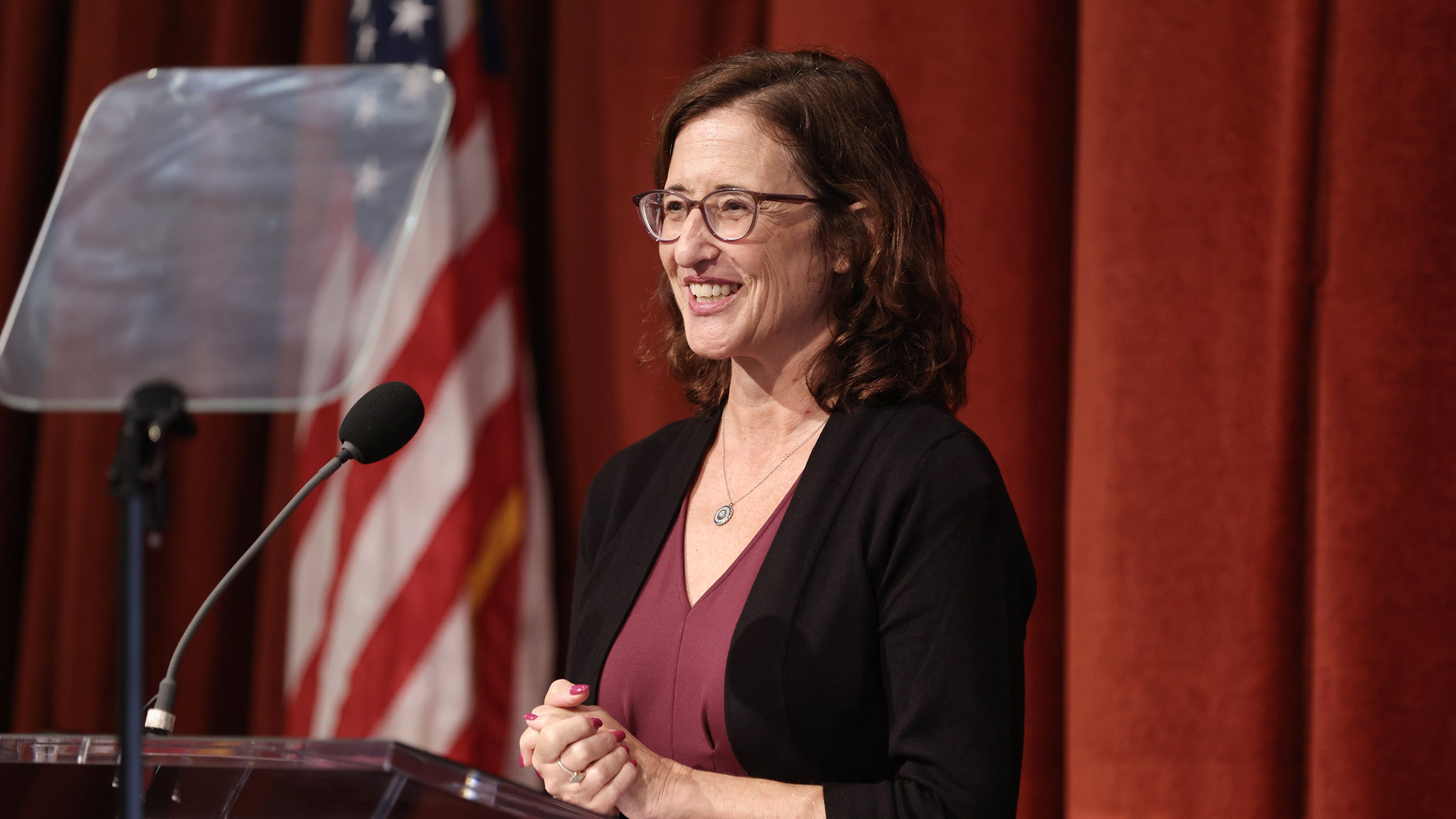
Laura Abrams enters her installation ceremony on Wednesday. (USC Photo/Steve Cohn)
Laura Abrams installed as dean of the USC Suzanne Dworak-Peck School of Social Work
The youth-welfare researcher wants to prepare Trojans for a rapidly changing world, “one that asks us to think outside the box and dream.”
Decades of scholarship and leadership have prepared Laura Abrams for her new job as dean of the USC Suzanne Dworak-Peck School of Social Work. But one thing Abrams was not ready for was a recent random act of kindness that would bring her to tears.
Abrams, who began serving as dean on July 1, said that a graduate student she had never met left her a card last week and wrote: “I just wanted to drop you anote to say thank you for stepping in to lead the school. I know that is a big job,and I wish you all the best in this endeavor.”
“Their words reminded me that being a dean is so much more than a job,” Abrams told an audience of more than 200 people gathered on Wednesday for her installation ceremony. “It is a responsibility entrusted to you by a community. I accept this responsibility with gratitude, humility and great optimism about what lies ahead.”
Standing on a podium inside the Town and Gown ballroom on the University Park Campus, Abrams vowed to listen, bring people together and answer big questions in true social worker tradition “by listening to people’s stories, examining evidence and turning what we learn into action.”
Abrams, also appointed as the David Lawrence Stein/Violet Goldberg Sachs Professor of Mental Health, comes to USC after having served as a professor in the Department of Social Welfare at the UCLA Luskin School of Public Affairs.
Her installation ceremony was attended by USC President Beong-Soo Kim, USC Executive Vice President Steven D. Shapiro, and many of the leaders of USC’s 22 other schools and academic units.
“People need help and support, including many of our own neighbors right here in Los Angeles,” Kim said during his remarks at the event. “That’s why it’s so meaningful for us at USC to be able to sustain our traditions of service and excellence in the field of social work. In Laura Abrams, we have found a leader who is deeply qualified to build upon and carry forward these traditions.”
Abrams has spent more than 30 years documenting and improving the well-being of incarcerated youth and young adults. Her work led to a state bill in California establishing a minimum age for juvenile legal prosecution, a model that is spreading nationally. She is also principal investigator of a groundbreaking study of juveniles sentenced to life without parole.
“This work is not easy, but that’s OK because, as social workers, we go toward the difficult,” Abrams said. “We go toward people who are hurting, and we go toward people and communities that are facing challenges.”
Discovering her life’s work
Abrams was 22 years old and fresh out of Brandeis University when she accepted a job at a group home. She witnessed how the young women there struggled, and she saw a system that wasn’t serving vulnerable young populations. This inspired Abrams to get a master’s degree and eventually a doctorate in social welfare from the University of California, Berkeley.
Championing major policies in the areas of child labor laws, consumer protection and Social Security became an immediate passion for Abrams. Working to alleviate suffering resonated strongly with her own values of social justice, human rights and equity.
“Social work asks us to sit with one person to listen and understand and strategize,” she said. “But it also then asks us to take a step back and ask, ‘Why is this happening? What is it about the policy, the institution or the system that is shaping this person’s life?’ I find that beautiful.”
Vision for work at USC
Abrams told the audience that she wants to prepare Trojans for a rapidly changing world, “one that asks us to think outside the box and dream.”
“I want our research to matter, not just inside the university or in a journal, but in the lives of the people and the communities we care about in Los Angeles and beyond,” she said. “I want us to embrace AI and technology, but without ever abandoning emotional intelligence or the human connection that lies at the heart of social work.”
She believes she will be able to accomplish that at USC where, during her short time as dean, she has discovered that “When you bring up an idea here, the response is rarely, ‘No, we can’t do that.’ It is, ‘How can we do that?’”
She wants students, faculty and staff to feel supported and challenged, and to know there’s nothing more important than creating a society where all people have the opportunity to thrive.
“I will lead in that spirit,” she said.
In their remarks, both Kim and Abrams paid tribute to USC Alfred E. Mann School of Pharmacy and Pharmaceutical Sciences Dean Vassilios Papadopoulos, who served as interim social work dean for an extended period prior to Abrams’ arrival.
Kim also thanked the school’s namesake, Suzanne Dworak-Peck, who was sitting in the front row.
“Thanks for everything that you do,” he said. “Thanks for being such an exemplary human being and leader, and for helping us carry on this incredible legacy with your school.”
After the ceremony, Dworak-Peck said she is looking forward to the school’s future and said of Abrams: “I am very happy about what I heard today — very happy.”
A proud family near and far
Abrams’ two sons could not attend the installation because they were on the opposite end of the country. Her older son, Eli, lives in Boston, where he does behavioral work with children; her younger son, Noah, is a senior at Skidmore College in New York.
But Abrams still had plenty of family on hand with husband Owen Fighter, parents Richard and Jane Abrams, sister Beth Abrams and brother-in-law Stuart Senator filling out the right front row.
“You’ve always encouraged me to dream big about my career and given me unconditional support,” Abrams said to her family.
After the formal program, a beaming Jane Abrams said of her daughter: “I’m filled with a mother’s love. She has done so many wonderful things for so many groups of people. This is the culmination of what she’s accomplished up to now.”
Richard Abrams said he has always kept up with his daughter’s academic work, but on Wednesday he was beyond impressed.
“It was really heartwarming because I had never heard Laura speak publicly before,” the father said. “I was taken aback. It really was an eye-opener into what a mature, responsible and effective leader she is going to be.”


