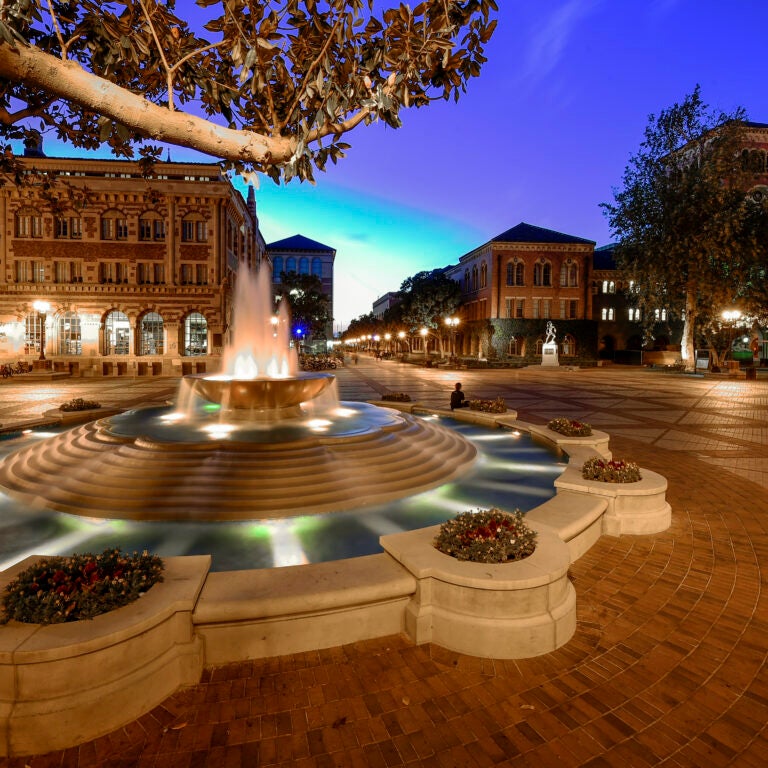

The Washington, D.C., presence is meant to strengthen engagement with policymakers and government leaders and expand the organization’s ability to share its research and expertise in the nation’s capital. (USC Photo/Sydney Walley)
USC Shoah Foundation opens D.C. center to strengthen engagement with policymakers
The Goldrich Family Center for Holocaust Memory and Contemporary Affairs at the USC Capital Campus will house the foundation’s CEO office, Countering Antisemitism Lab, government relations and leadership training programs, and original art and testimony exhibitions.
The USC Shoah Foundation on Tuesday announced the opening of a new office in Washington, D.C., at the USC Capital Campus.
Named by the Goldrich Family Foundation in memory of Holocaust survivor Jona Goldrich, the Washington, D.C., presence is meant to strengthen engagement with policymakers and government leaders and expand the organization’s ability to share its research and expertise in the nation’s capital.
“Establishing an office in Washington, D.C., demonstrates our commitment to engaging with policymakers in the nation’s capital,” said Robert J. Williams, chief executive officer and Finci-Viterbi Chair of the USC Shoah Foundation.
“From this new office, we will bring the lessons preserved in survivor and witness testimony directly into conversations about public policy,” he said. “By working with policymakers, government agencies and other leaders, we aim to help shape informed and effective approaches to confronting antisemitism, countering hate and preventing future atrocities.”
The office will also serve as a base for the Countering Antisemitism Lab, which develops data-driven research and training programs to address rising antisemitism. It will host leadership training for government, university and civic audiences.
Strengthening government relations work
The D.C. location strengthens the USC Shoah Foundation’s government relations efforts and its work convening policymakers, scholars, diplomats and civil society leaders around urgent challenges facing democratic societies.
“My father survived the Holocaust, dedicating his life to the belief that what happened to him and to so many others had to be remembered,” said Melinda Goldrich, president of the Goldrich Family Foundation. “It is deeply meaningful to our family to name the USC Shoah Foundation’s new Washington, D.C., home in his memory, and especially to see my father’s own words, ‘we are one humanity,’ become part of this space. He believed those words. To see them here, carrying his voice forward, is incredibly moving.”
In addition to its role as a policy and government engagement hub, the office will house a series of one-of-a-kind exhibitions blending art, testimony and contemporary reflection. Highlights include a photography exhibition of Roman Vishniac’s iconic images of prewar Jewish life in the 1930s, paired with archival testimony that offers new insight into the photographs; a painting from the late Marc Bennett’s Magen David Collection; and a new light installation by artist Nicola Anthony, We Are One Humanity, inspired by Goldrich’s words.
Preserving and sharing testimonies
The USC Shoah Foundation records, preserves and shares survivor and witness testimonies so that people can learn from the past, reflect on the present, and build a better future. Its collection includes more than 63,000 testimonies of survivors and witnesses of the Holocaust, contemporary antisemitism, the Armenian Genocide, and other mass atrocities and genocidal crimes of the 20th and 21st centuries. It is the largest collection of its kind in the world.
Established in 1994, the foundation found a permanent home at USC in 2006. With survivor testimony and offices in Los Angeles and Washington, D.C., its innovative programming, international initiatives and forward-looking research and education help preserve Holocaust memory and history, confront antisemitism and strengthen democratic values.


