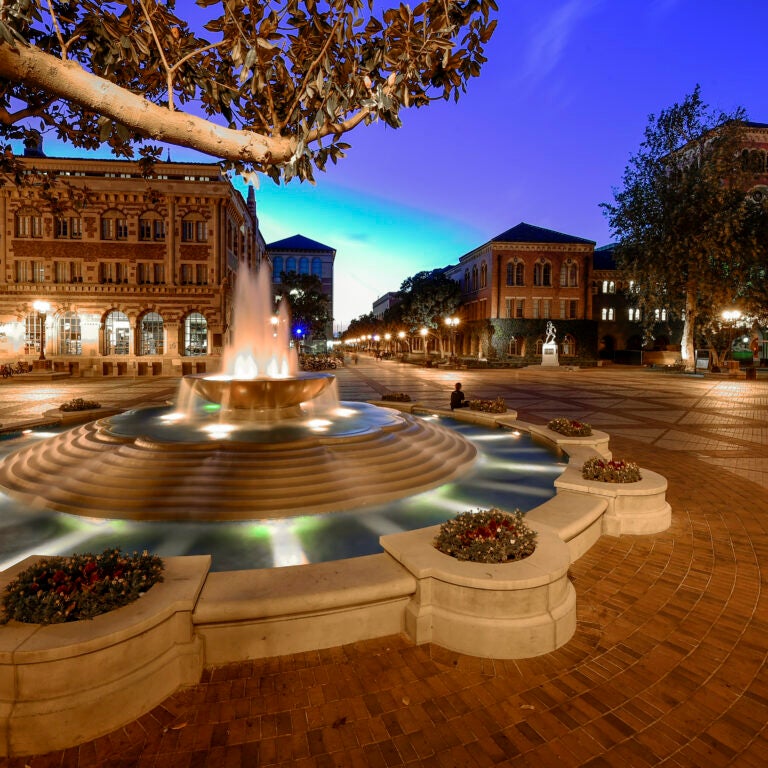

An implantable retinal patch for restoring vision is one of the university’s most cited examples of therapeutic success. (Illustration/aDerek Brahney)
From Lab to Launch: Inside USC’s Fast-Growing Ecosystem of Health Startups
From patches that restore vision to compounds that kill brain tumors, drug and device discoveries by USC researchers are reaching patients faster than ever before.
Ten years ago, two pediatric heart specialists approached USC biomedical engineer Gerald Loeb with an idea for a new pacemaker designed for babies, whose hearts are too small for conventional models.
The tiny device wouldn’t require open-chest surgery, sit inside the heart or have wire leads, which often break. Inserted under the breastbone through a small tube, the miniature pacemaker — a little bigger than a vitamin E capsule — would fit securely between the heart and its surrounding pericardial membrane.
Loeb is no stranger to medical innovation. A biomedical engineering professor at the USC Viterbi School of Engineering, Loeb developed and patented an artificial fingertip with a complete sense of touch that was licensed to a successful spin-off company from his USC lab. He specializes in electronic devices that connect with the nervous system.
“My career consists of people coming in with crazy ideas and deciding which ones are practical enough to give a shot,” Loeb says.
The pericardial micro pacemaker is getting its shot. He and Yaniv Bar-Cohen, a pediatric heart specialist at the Keck School of Medicine of USC and Children’s Hospital Los Angeles, developed, patented and successfully demonstrated a working model. Bar-Cohen is in talks with pacemaker companies that can bring their device to market. They envision it being used in babies, children and adults.
From pill-sized pacemakers to stem cell therapies and new cancer treatments, USC researchers are collaborating to advance medical innovations, address complex health challenges and improve lives. Trojan researchers across the sciences are seeking to cure blindness, develop new testing options for cancers such as ovarian and breast cancers, and delay the onset of arthritis. They are also finding new ways to detect and slow the progression of Alzheimer’s disease.
“At USC, we don’t just imagine the future of medicine; we engineer it, we patent it, we launch it,” says Ishwar K. Puri, USC’s senior vice president of research and innovation. “Our researchers are redefining what’s possible. This is what it means to innovate like a Trojan.”
The USC Stevens Center for Innovation plays a pivotal role in many of these efforts, managing the intellectual property generated from more than $1.2 billion in annual research funding across medicine, engineering and the sciences — a scale that reflects USC’s growing influence in shaping the future of health technologies.
“We’re seeing more faculty startups launch with strong science and real commercial potential,” says Erin Overstreet, executive director at the Stevens Center. “We want to make sure we’re helping them build the right foundation — from patents to partnerships.”
At USC, we don’t just imagine the future of medicine; we engineer it, we patent it, we launch it.
Ishwar K. Puri, USC’s senior vice president of research and innovation
A long lead
The path from discovery in the lab to the marketplace is painstakingly slow. Each promising treatment must go through rigorous scientific review before it can advance to clinical trial and eventually to FDA review and approval. According to some estimates, the cost of producing a single FDA-approved drug ranges from $1 billion to $3 billion over a 10- to 15-year period. The odds of success are slim: Only 3%, give or take, win FDA approval.
USC scientists are on the front line of finding ways to accelerate discovery and compress the timeline. They are launching startups to inspire investment and working closely with private industry.
USC’s Vsevolod “Seva” Katritch is using AI and computational methods to screen billions of compounds to disrupt the earliest — and most time-consuming — phase of drug discovery: the identification of “hits” and development of “leads.” He and Charles McKenna, professor of chemistry and pharmaceutical sciences, host workshops to encourage AI drug discovery. Annie Wong- Beringer, associate dean for research at the USC Alfred E. Mann School of Pharmacy and Pharmaceutical Sciences, is using organon- a-chip technology (where cells from specific organs, such as the heart, are grown on silicone wafers) to screen potential drugs for issues such as liver toxicity earlier in the process.
“USC is not only publishing discoveries but actively developing therapies and spinning out biotech companies,” says Steve Kay, who directs the USC Michelson Center for Convergent Bioscience and is the co-director of the USC Norris Center for Cancer Drug Development. “We’re building an ecosystem that turns basic science into treatments — especially for diseases affecting our local population, like pancreatic cancer, leukemia and Alzheimer’s.”
“Historically, universities stopped at publishing discovery research — insights into pathways, cell types, animal models — while pharma took it from there,” continues Kay, a University and Provost Professor of Neurology, Biomedical Engineering and Quantitative and Computational Biology. “What we’re doing now is moving our discoveries further along the commercialization path before handing them off. That means more value retained at USC and more ownership for inventors.”
Here’s a sample of USC-licensed startups, drugs and devices:
- Be Biopharma has licensed technology developed by microbiologist and Keck School of Medicine Distinguished Professor Paula Cannon to edit the genes of the body’s own B cells to express therapeutic antibodies for indications including cancer, autoimmune disease, infectious disease and central nervous system applications.
- AcuraStem, a startup co-founded by Justin Ichida, is developing drugs to treat ALS and frontotemporal dementia. In late 2023, AcuraStem signed an exclusive licensing agreement with pharmaceutical giant Takeda to bring the discoveries to market.
- Synchronicity Pharma, a biotech startup co-founded by Steve Kay, has completed early safety trials in humans for a compound that selectively attacks glioblastoma — a deadly form of brain cancer — stem cells. The compound, SHP1705, targets the circadian clock proteins hijacked by glioblastoma stem cells, impairing the cancer cells’ ability to survive and grow. Circadian clock proteins regulate the body’s sleep-wake cycle and other daily rhythms.
- Plurocart, a startup founded by Denis Evseenko at Keck School of Medicine, is developing a “regenerative pouch” to replace cartilage that’s been damaged by a fall, sports injury or other trauma. The pouch contains hundreds of thousands of young cartilage cells derived from stem cells. “It’s a little reparative structure that you can surgically deliver right into the cartilage defect,” Evseenko says.
USC is building an ecosystem that turns basic science into treatments — especially for diseases affecting our local population.
Steve Kay, director of the USC Michelson Center for Convergent Bioscience and co-director of the USC Norris Center for Cancer Drug Development

Interdisciplinary Breakthroughs
The famed inventor Nikola Tesla is believed to have said, “Be alone — that is the secret to invention.”
For Trojan inventors like Charles Liu, the opposite is true: Their secret to invention is to work as a team. Even though the process may take years, licensure does not dim Liu’s enthusiasm for helping patients recover function from brain injuries or diseases.
Co-founder of USC’s Neurorestoration Center and professor of clinical neurological surgery, urology and surgery at the Keck School of Medicine, Liu specializes in the creation of implantable devices that respond in real time to abnormal brain activity. His prosthetics for the brain are designed to help patients who suffer from brain conditions such as epilepsy, Parkinson’s disease, memory loss and more.
Through a combination of engineering and medicine, he is a healer in the rapidly emerging field of biomedicine known as neuroprosthetics. “The hope is that neuroprosthetics will become an important tool for functional neurorestoration in human patients, which will work in synergy with other strategies such as regenerative medicine and neuromodulation-enhanced learning,” Liu says. “The hope is that all aspects of human neurological disabilities can be restored beyond what conventional healing and rehabilitation can achieve.”
Associate Professor of Neurological Surgery and of Biomedical Engineering at the USC Viterbi School of Engineering Dong Song, who often collaborates with Liu, focuses on addressing brain health issues through engineering.
For instance, he is working on a brain prosthesis to restore episodic memory in patients who suffer from memory-impairing conditions such as neurological disease or injuries.
Using a computational model, his team records neural signals from one part of the hippocampus and stimulates another to rebuild broken memory pathways by using implantable brain devices.
“Within the next five to 10 years, our goal is for this device to transition from proof-of-concept studies to broader clinical trials, ultimately providing a therapeutic option for conditions like traumatic brain injury and early-stage Alzheimer’s disease,” Song says.
Getting to Yes
At USC, some scientists bring their early ideas to the Stevens Center, which helps turn rough prototypes into patented devices. That process often extends to launching a startup company where strong intellectual property can give investors the confidence to fund the testing and development needed to bring an invention to market.
In recent years, the center has refined the way it handles technology transfer — the process of moving university research into the real world. Since joining the center in January 2024, Overstreet has emphasized investing early in high-quality patent applications and being more selective about which inventions to pursue patent protections for.
“We don’t try to patent every idea that comes through our office,” she explains. “Instead, after a careful review, we move forward with patents on about two-thirds of the inventions we see. For those, we put in the work to draft applications that clearly define what makes the invention new and protectable. Strong patents not only stand up if challenged — they are also more attractive to companies and investors, making them far more licensable assets for USC and our inventors.”
The center’s licensing team now numbers more than 20 professionals who work closely with faculty to negotiate startup-friendly agreements. Many deals begin with low-cost, short-term options to reduce risk for early-stage companies. Later, they are upgraded to full licenses once funding is secured.
“Our job is to reduce friction,” Overstreet says. “We want to get to yes, and we want startups to succeed.”
The Stevens Center oversees licensing of all technologies at USC, including diagnostics and medical devices. Companies like CpG Diagnostics and Regenerative Patch Technologies (RPT) — co-founded by Mark Humayun of USC Viterbi, the USC Roski Eye Institute and Keck School of Medicine — are part of USC’s expanding innovation footprint. RPT developed an implantable retinal patch for restoring vision in people with age-related macular degeneration. It remains one of the university’s most cited examples of therapeutic success.
Recent studies, backed in part by the taxpayer-supported California Institute for Regenerative Medicine, indicate the patch appears regenerative, not just slowing the degenerative disease but also reversing its course. Clinical studies are underway.
Signals of Strength
As the life-sciences industry shifts toward personalized and cell-based therapies, Overstreet believes USC is better positioned than ever to rise among the top institutions for innovation. Recent deals with well-capitalized companies, such as Be Biopharma, reflect a maturing pipeline of faculty-led ventures — and illustrate an unrelenting determination that is a hallmark of USC research.
“These are signals of strength,” she says. “They show what’s possible when you combine groundbreaking research with strong intellectual property and the right partnerships.”
With more than $1.2 billion in annual research activity and a sharpened focus on translational outcomes, Trojan inventors are laying the groundwork for a future where USC discoveries save and improve more lives, faster than before.


