

Neeraj Sood, left, and Jay Bhattacharya have known each other for three decades. (USC Photo/Sean Dube)
NIH Director Jay Bhattacharya gets candid about academic freedom at USC Open Dialogue Project event
“I don’t see any way through but to be brave,” Bhattacharya said in conversation with USC Price Professor Neeraj Sood.
Professor Neeraj Sood of the USC Price School of Public Policy and National Institutes of Health Director Jay Bhattacharya have known each other for three decades and worked together on various projects in the past.
So, when they took the stage inside the Wallis Annenberg Hall Forum on USC’s University Park Campus on April 9 for a conversation titled “In Dialogue: Advancing Freedom of Expression and Inquiry,” there was initially some mutual teasing and anecdotes shared.
But soon enough, the conversation — part of the USC Open Dialogue Project — turned to hard questions about academic freedom, scientific integrity and how universities can be a place of intellectual diversity.
Bhattacharya, a former professor of medicine at Stanford University who sparked controversy in 2020 when he was publicly critical of lockdowns and mask mandates as a response to the COVID-19 pandemic, emphasized the importance of both negative and positive academic freedom, in which institutions do not persecute unpopular ideas and campus culture tolerates diverse viewpoints.
He said that most university scholars “just want to be allowed to do their work without political interference, without being ostracized by the fellow community scholars.”
“There’s a relatively small number of very, very intolerant faculty who cannot stand the idea that they work for an institution where ideas that they despise are sometimes represented, and they’re often the loudest voices in a university,” he said.
USC Open Dialogue Project: Celebrating intellectual courage
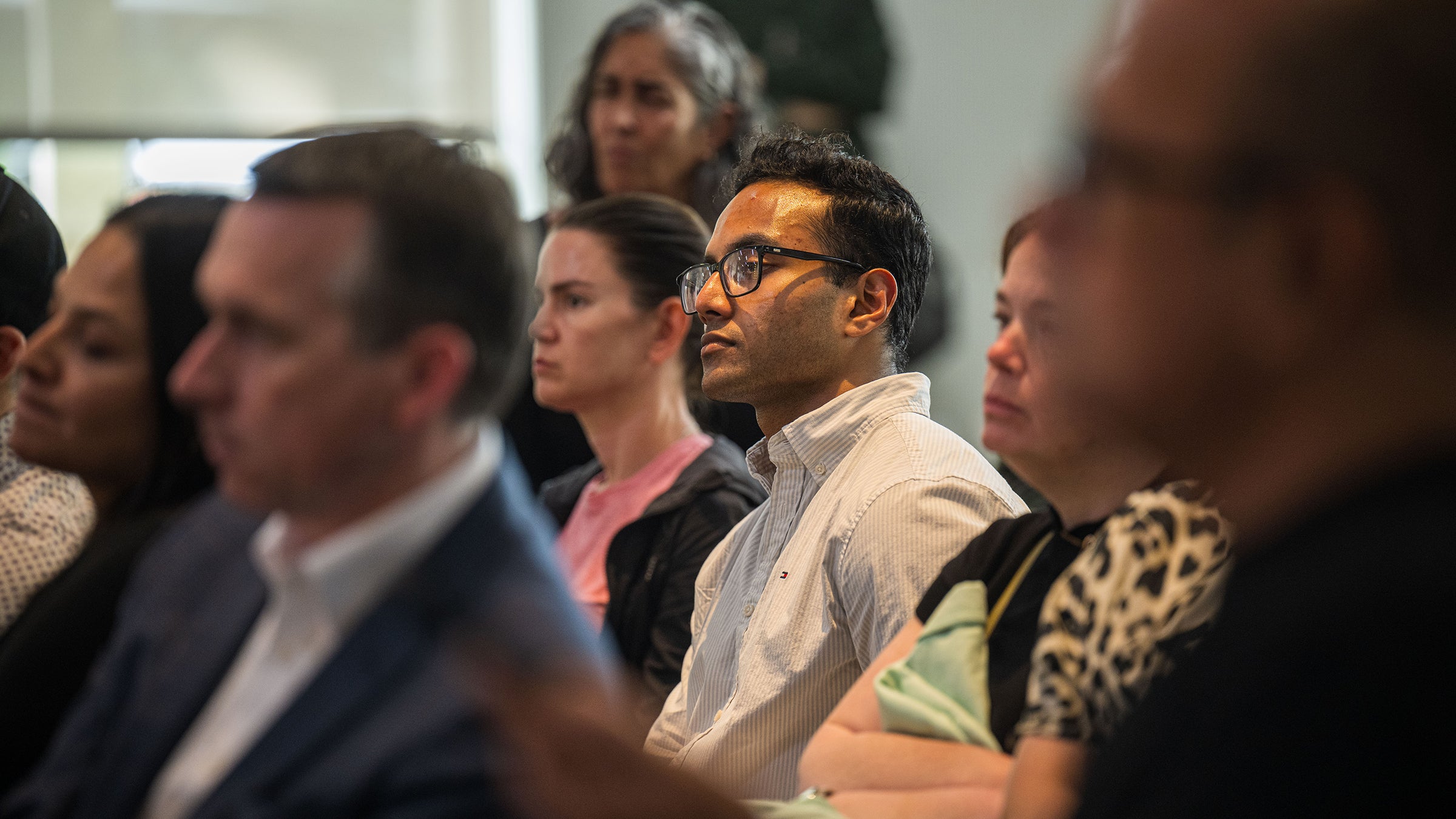
Welcoming an audience of more than 150 people assembled for the event, USC Provost and Senior Vice President for Academic Affairs Andrew T. Guzman outlined the ground rules for the discussion: Abandon the notion of winning, maintain curiosity and focus on ideas rather than personal attacks.
“USC is, and needs to remain, a place where intellectual courage is celebrated,” Guzman said, “where disagreement is true as an invitation to learn bilaterally, rather than a cause for alarm.”

The Open Dialogue Project is an initiative launched by USC President Beong-Soo Kim that seeks to advance academic freedom, expression and discourse.
During his discussion with the NIH director, Sood — director of the Open Dialogue Project — asked Bhattacharya for his advice on how to best achieve academic freedom and open discourse so that USC faculty, students and staff can feel comfortable having tough conversations.
“I don’t see any way through but to be brave,” Bhattacharya said. “A project like this is, frankly, it’s an invitation to be brave. … You have to allow conversations to happen that people don’t want to have happen.”
When speaking out leads to backlash
As a professor of medicine, economics and health research policy at Stanford, Bhattacharya received nationwide attention for co-writing the essay “Is the Coronavirus as Deadly as They Say?” published in The Wall Street Journal in March 2020. He released a heavily scrutinized serology study the next month. In October 2020, he also co-authored an open letter advocating for the lifting of pandemic restrictions for lower-risk groups of people to develop herd immunity.
Bhattacharya said his research and views made him “anathema” to most of his Stanford colleagues, and he faced tremendous pressure from the university. Although an investigation into his research was later dropped, he said he paid a heavy personal and professional price.
“It was very clear to me that my academic career was over,” he said. “I couldn’t eat. I couldn’t sleep. I lost 30 pounds.”
But Bhattacharya didn’t back down.
“I decided that even if I ended my career as academic, I was going to start speaking up pretty loudly as I could in a data-driven way on the lockdowns,” he said. “I essentially decided that I was going to speak in ways that I knew would excommunicate me from the academic community that I love.”
Bhattacharya said he has no regrets, while acknowledging that in an academic setting, “no one is going to look at my research and treat it in a good faith way.”
“It’s cheap and easy for me to say, ‘Be brave,’” he said. “But I don’t know how else to do it. I would love to see academic cultures that don’t require that kind of bravery in order to say, ‘I don’t agree.’”
He left his position and became an emeritus professor at Stanford last year so that he could start his position at the NIH. Since February, Bhattacharya has also served as the acting director of the Centers for Disease Control and Prevention.

Students appreciate civilized tone of conversation
Among the students in the audience was junior Devin Norris of the USC Dornsife College of Letters, Arts and Sciences, who first learned about Bhattacharya during the pandemic.
“It was very cool to hear him in person and share his ideas,” Norris said. “Some of it I feel I’m more aligned with, and some stuff I’m not. What I genuinely appreciate most about this event was that I had the opportunity to hear these ideas in a way where nothing was stifled, everything was organic and it just flowed.”
USC Dornsife senior Tony Yan, who plans to attend medical school, said he didn’t want to miss the opportunity to hear what the NIH director had to say.
“I think that it’s very important to keep an open mind and to get new perspective on what’s happening in science,” Yan said. “It absolutely felt super relaxed hearing him talk with the moderator, and very conversational. No attacks on any other person.”