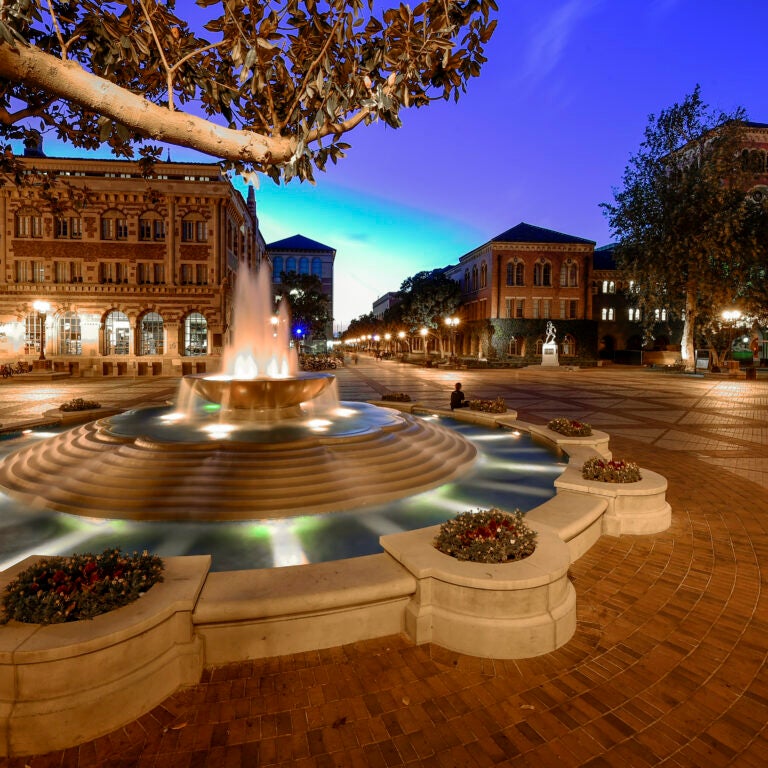

The exhibition features some of the most significant founding-era documents in celebration of the 250th anniversary of the United States. (USC Photo/Greg Grudt)
Rare documents from National Archives’ Freedom Plane tour draw history buffs and more to USC Fisher Museum
“These are old documents, but they are still alive in a way,” says USC doctoral student Sharon Salgado Martinez.
Standing in front of a rare engraved copy of the Declaration of Independence inside the USC Fisher Museum of Art on Monday, USC Distinguished Professor Peter C. Mancall advised his history class to take in the entirety of what the original founding-era documents on display embodied.
“There is a story being told to you,” Mancall said to the 16 students who accompanied him for a special class session at the museum exhibit “Freedom Plane National Tour: Documents That Forged a Nation.”

“Don’t just look at the documents,” Mancall said. “Think about how they’re being presented. Look at the captions, the sequencing. Try to figure out what the story is.”
The students were among the many people who made their way to the museum — located along Exposition Boulevard in a quiet section of USC’s University Park Campus — to view the exhibit during its first five days. USC is the only university to host the documents during their eight-city national tour.
The exhibit runs through May 3 and features some of the most significant founding-era documents in celebration of the 250th anniversary of the United States. The documents include the Articles of Association (1774), the Oaths of Allegiance (1778), a William J. Stone engraving of the Declaration of Independence (1823), the Treaty of Paris (1783), David Brearley’s secret printing of the Constitution (1787), state delegation votes approving the Constitution (1787) and a Senate markup of the Bill of Rights (1789).
“These were people who were real, who were wrestling with new political circumstances, new sets of ideas and how to establish them,” Mancall said to his students. “We can see them working through those ideas. It shows us the humanity of the founding.”
The documents arrived in Los Angeles on April 13 on a special Boeing 737 for the third stop of the traveling exhibition being brought to the public by the U.S. National Archives and Records Administration and the National Archives Foundation.
Students delve into their history
For the students and other visitors, the 1783 Treaty of Paris was the most fascinating in the collection because it is the actual, official document on display and not an earlier draft or later reproduction. The treaty ended the American Revolutionary War and was signed by John Adams and Benjamin Franklin, among others.
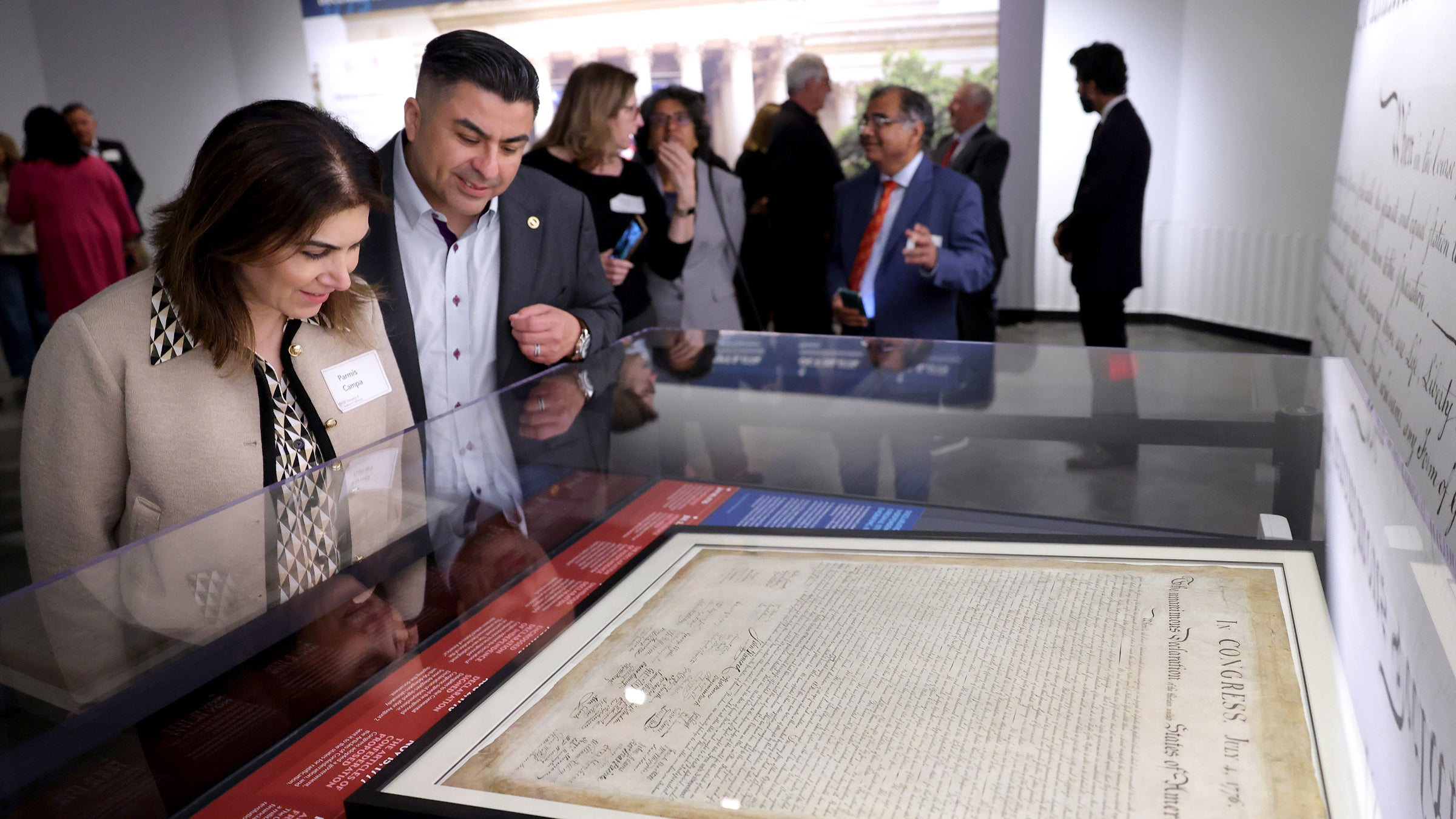
“Looking at these documents, it was just interesting to see people kind of standing up for themselves,” junior Jayden Adams-Ruiz of the USC School of Dramatic Arts said after viewing the exhibit with Mancall’s class on Monday. “They were a bunch of rich, land-owning white men, but they were revolutionaries. They were standing up against what they saw as a tyrannical government, and they took a stand.”
 Mancall clearly relished the opportunity to show the exhibit to his students.
“We’ve been studying these documents all semester, and I was very excited to see their excitement,” he said in an interview. “I could see them leaning over these display cases wanting to get closer. Seeing that excitement is such gratification for a professor.”
Visitors appreciate seeing history up close
Doctoral student Sharon Salgado Martinez of the USC Dornsife College of Letters, Arts and Sciences took in the exhibit at a preview event on Thursday and walked out of the museum profoundly moved.
“These are old documents, but they are still alive in a way,” Salgado Martinez said. “It’s significant to know the thought process and the way they were building and creating a new nation. We’ve always known of declaring independence in 1776, but it took decades to actually acquire independence.”

Director of USC Museums Bethany Montagano told the crowd at the preview party that more than 20,000 students, families, scholars and members of the broader community will have the opportunity to take in the exhibit before it closes early next month.
 “We have people flying in from all over the West Coast to see [these documents], so we’re very, very excited about that,” Montagano said. “These are not just artifacts. They’re a physical record of ideas that built a nation, debated, revised, signed and brought to life by real people facing uncertain futures.”
Among the preview guests was Dafer Dakhil, executive director of the Omar Ibn Al-Khattab Foundation, who found himself waxing nostalgic with other attendees about trips to Washington, D.C., in their youth to see the original Declaration of Independence at the National Archives Museum.
“But a lot of these documents we’ve never seen,” Dakhil said of the Freedom Plane collection. “It was a big ‘wow’ moment for everybody. It’s just reminding us where our roots are and how we all came together and how we need to stay together.”
Opening day impressions
William Edic, an attorney from Woodland Hills, and his son, a USC alumnus also named William, were among the visitors on the exhibit’s official opening day on Friday. Edic carefully examined the Treaty of Paris and at one point said to his son, “That’s where Ben Franklin rested his hand when he signed.”
“The timeline was a good way to organize it,” Edic said later in the lobby of the museum. “I think a lot of people don’t realize the long period of time between the [Revolutionary War] and when the Constitution was actually completed.”

Las Vegas resident Claudia DeGeorge was in town for the Los Angeles Times Festival of Books, held on USC’s University Park Campus on Saturday and Sunday, and enthusiastically added the exhibit to her plans.
“It brings history to life, and you really know that it happened,” DeGeorge said before exiting the museum. “It’s not just something in the books.”


