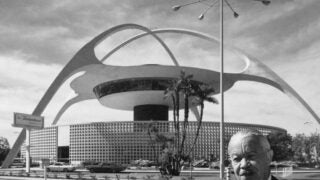

Paul R. Williams (left) standing with two men at Compton Imperial Housing Project site, ca. 1952. Merge Studios. Gelatin silver print. Sheet: 8.125 × 10 in. Image: 7.375 × 9.25 in. Jointly owned by the Getty Research Institute (2020.M.6) and the University of Southern California School of Architecture. © Merge Studios.
USC Fisher Museum of Art hosts exhibit on groundbreaking architect
Paul R. Williams: An Architect Considered includes rarely seen archival material and commissioned works by leading contemporary artists, architects and filmmakers.
USC Fisher Museum of Art will present the first major exhibition to explore the contributions of groundbreaking architect Paul R. Williams to modern multifamily housing and urban Black communities. On view Aug. 18, 2026, through March 13, 2027, Paul R. Williams: An Architect Considered debuts rarely seen archival drawings, photographs and plans, and pairs them with newly commissioned works by leading contemporary artists, architects and filmmakers, reframing Williams’ long-underrecognized work and addressing urgent conversations about race, equity and the future of American cities.
A pivotal figure in 20th-century architecture and civil rights advocacy who studied architectural engineering at USC, Williams was the first Black architect licensed west of the Mississippi. He was also the first known Black member of the American Institute of Architects nationwide (1923), its first Black fellow (1957) and the first and only Black architect to receive its highest honor, the Gold Medal (posthumously, 2017). During a career spanning nearly six decades, Williams designed more than 3,000 structures, making him one of the most prolific and influential architects of his time.
“Paul R. Williams’ impact on Los Angeles is immeasurable — it is difficult to find an area of the city where he did not help shape the architectural aesthetic that makes Los Angeles so distinctive today,” said Bethany Montagano, director of USC Museums. “He approached every project as a true artist, whether designing grand residences, multifamily housing or visionary urban plans, and it is long overdue for his work to be celebrated through an exhibition of this scope. Bringing these materials into public view reflects USC’s commitment to advancing scholarship, public dialogue and new perspectives on Williams’ enduring legacy.”
Highlighting 35 housing projects from his long career, the exhibition spotlights Williams’ innovative solutions for collective living, primarily in Los Angeles, during the second Great Migration, a period of rapid urbanization. More than 60 items from the archive, which was jointly acquired in 2020 by Getty Research Institute and the USC School of Architecture, will be shown in conversation with major new commissions by Edgar Arceneaux, Current Interests (Matthew Au and Mira Henry), enFOLD Collective (Dana McKinney White and Megan Echols), Darell W. Fields, David Hartt, Cory Henry and Amanda Williams, as well as a selection of existing works by photographers Julius Shulman and Janna Ireland.
While Williams’ stately homes designed for the wealthy elite have been widely acclaimed, his solutions for affordable multifamily housing have received less attention, even though Williams relentlessly sought to reimagine modernity for a diverse range of clients and users throughout his career.

[(Mexico): exterior perspective], September 25, 1959, perspective drawing, 1959. Graphite, colored pencil on translucent paper. 14 x 16 in. Jointly owned by the Getty Research Institute (2020.M.6) and the University of Southern California School of Architecture. ©Della M. Williams Trust Dated Dec. 15, 1988.
The USC Fisher Museum is one of three Los Angeles institutions — along with Getty and the Los Angeles County Museum of Art — presenting coordinated exhibitions celebrating Williams beginning this fall. LACMA’s Paul R. Williams: Architect for Living will run from Nov. 15, 2026, through May 31, 2027, while Getty’s Paul R. Williams: Architecture Across the Color Line will be displayed from Dec. 15, 2026, through March 14, 2027.
The exhibitions coincide with Getty’s publication of I Am an Architect: Paul R. Williams and His Archive, the first research-based, archivally driven book on Williams, which features a range of essays by the curators from all three institutions.
Organized jointly by School of Architecture and the USC Fisher Museum, Paul R. Williams: An Architect Considered is curated by Valery Augustin, associate professor in the practice of architecture at USC; Milton S.F. Curry, professor of architecture and senior associate dean at Cornell University; and Amy Murphy, professor of architecture and associate dean of faculty affairs at USC. Augustin is exhibition designer, with graphic design by Morcos Key.
“We wanted to offer a new framework for understanding Williams’ vision through the intersecting histories of modernity, race, domesticity and urban housing,” Curry said. “Visitors will be surprised to discover how much of Williams’ work surrounds us in Los Angeles and how powerfully it resonates with contemporary artists today. They will also encounter the tension at the heart of the exhibition: Although many of the communities connected to his multifamily housing projects were later undermined by systemic disinvestment and inequality, Williams imagined innovative and dignified possibilities for collective living, particularly for Black Angelenos.”
Visitor experience
Staged across the USC Fisher Museum’s four galleries, the exhibition unfolds through a series of thematic sections tracing the architect’s creative vision for affordable multifamily housing for diverse populations.
In the museum’s center gallery and north wing, visitors encounter Williams’ drawings, grouped thematically by type of project, along with materials that place his work within the explosive growth of Los Angeles during the early and mid-20th century, when the city expanded from roughly 500,000 to nearly 2.8 million residents. As the population surged, Williams experimented with new approaches to multiunit residential design, ranging from single-occupancy YMCAs in Hollywood and South Los Angeles to modest multiunit walkups in Beverly Hills and San Diego. These projects offered alternatives to the single-family home and reflected Williams’ interest in expanding access to modern living.
Through Williams’ public housing projects such as Pueblo del Rio, Hacienda Village (now Gonzaque Village) and Nickerson Gardens, the exhibition reveals his lifelong commitment to using design to create dignity and opportunity for communities most in need.
Williams’ interest in innovation and affordability are also highlighted in sections dedicated to prefabrication and comprehensive (master) planning. Drawings for experimental concrete, aluminum and demountable homes demonstrate Williams’ efforts to expand access to homeownership through new materials and industrial building techniques.
Many of the featured projects are located outside Southern California, reflecting the extended reach of his practice, and range from an early collaboration with Hilyard Robinson on the Langston Terrace public housing project in Washington, D.C., to later large-scale urban renewal and master planning projects in Chicago, Nashville and Las Vegas.
The drawings of Williams’ sophisticated midcentury apartment designs, including those for Bay Towers and Blue Lagoon Apartments, reveal his refined command of line, light, form and spatial openness. Others highlight his versatile use of courtyard housing, garden apartments, subdivisions and tract housing developments. In sum, they shed light on how he skillfully adapted architecture to Southern California’s climate, creating shared outdoor spaces and more flexible approaches to middle-class living.
Commissioned artworks
In two large galleries straddling the center hall, archival materials are in dialogue with newly commissioned contemporary works by artists and architects who address Williams’ legacy with new perspectives on housing, memory and race.
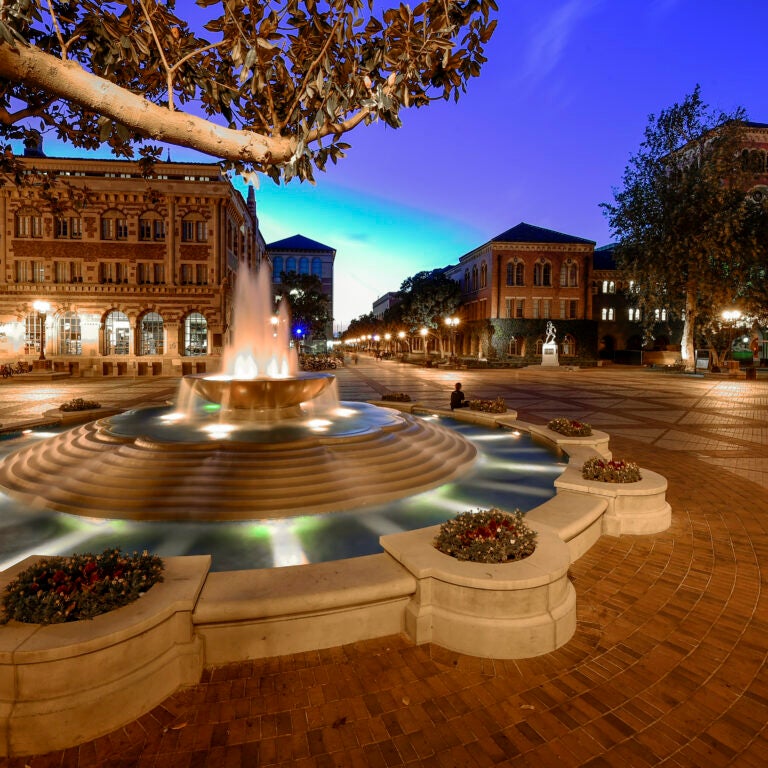
A film by David Hartt, Some Los Angeles Apartments & Houses Between 1271 West 35th Street and 1194 West 36th Place (2026), follows a young skateboarder through South Los Angeles to the USC University Park Campus, linking historic sites associated with Williams — including his own home and that of the legendary Bill “Bojangles” Robinson — with the cityscape as it appears now.

Williams Ghosts (2025-26), three large-scale paintings by multimedia artist Edgar Arceneaux, were made of mirrored glass and silver nitrate so that when they were left inside several of Williams’ projects in Reno, Nev., last year, their exposed silver surfaces absorbed proteins from the buildings’ interior air. The result is a visual response to the state of the buildings today and how they contrast with Williams’ original intentions.
Amanda Williams’ Then, to Complete the Picture (2026) fashions a small-scale version of a real estate advertising sign for Paul R. Williams Westside Park/Berkley Square project (1949), the first Black middle-class development in Las Vegas to be backed by the Federal Housing Administration. The artist will also place a full-scale billboard at Crenshaw and Washington boulevards in L.A. featuring the Williams quote “Fortunately there is no rule that says good taste is governed by income.”
The architects commissioned for the exhibition engage with Williams on a formal, architectural level. With the sculptural installation You/us in the Interstice (2026), enFOLD Collective explores the thresholds and vestibules of transition in Williams’ affordable housing projects. Darell Wayne Fields’ Forensics: The Syntax of Paul R. Williams (2026) teases out how Williams’ domestic work for the middle class reveals a distinct mode of Black expression in architecture as a type of Black vernacular. Cory Henry’s The Other Side of the Table (2026) and Current Interest’s Slow Dance (2026) explore Williams’ role as a practicing architect via mixed-media works that contemplate his imprint on the world today.
Significant funding for this exhibition has been provided by the Mellon Foundation.
All exhibitions are underwritten by the USC Fisher Museum of Art Exhibition Fund. Annual leadership support is generously provided by Boris Dramov and Bonnie Fisher, and by Akieva and Martin Jacobs. Major support is provided by Dana Dramov McCollough and Brady McCollough.