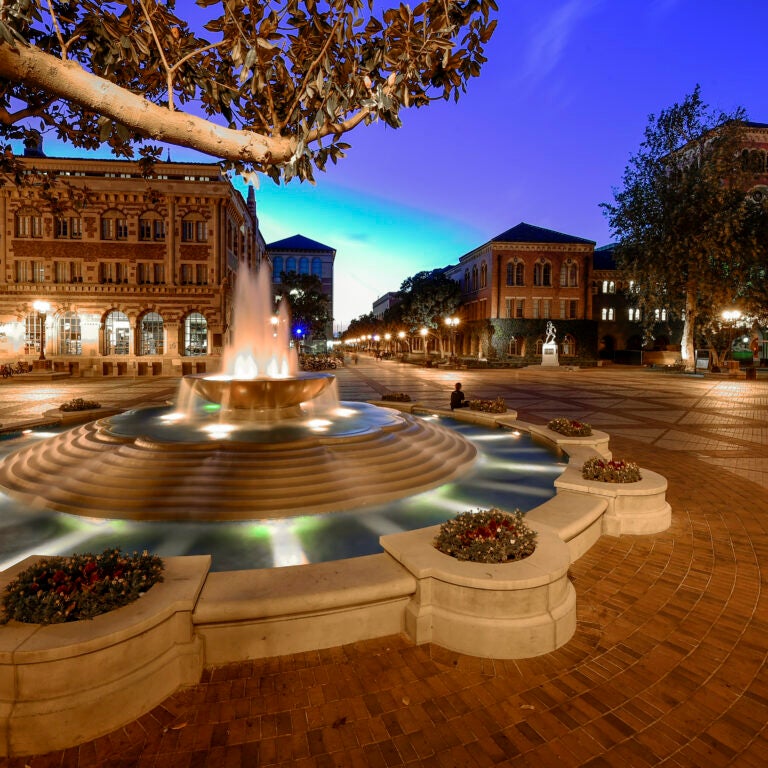

This summer, USC is providing several new summer-only courses as well as classes that are in high demand during the fall and spring. (USC Photo/Kristopher Head)
New summer session options offer students a more immersive, flexible experience
New courses and a revamped format make the summer session more attractive to USC students.
Rita Barakat has always liked the summer term. As an assistant professor of biological sciences at the USC Dornsife College of Letters, Arts and Sciences, she enjoys the reduced class sizes, which can be as small as 20 students in one section. Not only does it allow her to form closer relationships with her students, but she sees the difference in how her students approach the subject as well.
“You’re going from a really big class where students can feel overwhelmed by the number of [classmates] to a much more intimate setting,” Barakat said. “The way to really see if students understand cell biology and physiology is to engage in problem solving, critical thinking and real-world scenarios — and it’s very logistically difficult to do that with a super large class.”
However, as summers are often seen as a time to complete internships or take a break from schoolwork, enrollment numbers are lower than during the fall and spring semesters.
But this summer is different. The university is providing several new summer-only courses as well as classes that are in high demand during the regular fall and spring semesters. The goal is to encourage students to consider summer as another opportunity to fulfill degree requirements or to try a new class or subject area. A special USC website has details on the summer opportunities.
“We really want people to think of summer not just as an afterthought, but as something to help them achieve their academic goals,” said Andrew McConnell Stott, vice provost for academic programs and dean of the USC Graduate School. “We want them to think of summer as a viable academic session that they can utilize.”

Another addition to help students with other responsibilities during the summer is what Stott calls “summer flex modality: essentially an asynchronous, online, flipped classroom,” where students can do most of the work at their own pace. Instead of spending all their time on Zoom for an online class, students can schedule their learning around other activities and simply check in with faculty.
“It should really allow students to manage their schedule in a way that works for them during the summer and also allow them to study wherever they are in the world,” Stott said.
USC summer term: New courses with flexible schedules
Some professors, such as clinical occupational therapy professor Ashley Uyeshiro Simon, are teaching summer classes for the first time. Uyeshiro Simon’s class on animal and human interconnections usually takes place during the fall and spring semesters, which she said limits the opportunities for field experience in class. She’s looking forward to the opportunities that come with a more flexible schedule.
“Teaching or taking the class in the summer affords you a lot of different opportunities that you wouldn’t have during the year,” said Uyeshiro Simon, director of the minor in occupational science program at the USC Mrs. T.H. Chan Division of Occupational Science and Occupational Therapy.
Since fewer courses are offered in the summer than during fall and spring, there are fewer classes stacked back-to-back. For a professor who likes to provide her students with a hands-on learning experience, this allows time for more field trip opportunities.
“It really affords us a lot more flexibility,” she said. “The [schedule] now opens up to where our class can meet at a site and really learn from the people in the communities.”
A more immersive experience during USC summer term
For Mary Traester, associate professor of writing at USC Dornsife, summer’s smaller class sizes provide a close-knit feeling that can’t be replicated during the school year. This summer, Traester is teaching Writing 340, which she has taught in various semesters since 2020.
“The summer course is actually vibrant and as valuable and as rigorous as anything in the fall and spring,” Traester said. “It gathers the same caliber of students with the same engagement and the same investment in their futures and careers.”
In fact, Traester said many of her students are looking to make a final stamp on their college careers; to her, that’s one of the best parts about teaching in the summer.
“The students who take the course in the summer are often highly motivated, very close to graduation and thinking very deeply about what’s next,” Traester said. “I tend to pitch my course as a bookend to their time at USC, to have them think about who they’ve become as thinkers and writers during these years that they’ve spent on our campus.”

Added benefit of accessible, value-driven classes
The in-person course options aren’t just limited to students in the Los Angeles area either: Students can take advantage of summer options at the USC Capital Campus in Washington, D.C. The Capital Campus offers general education classes and connects students with internship opportunities. Unique to USC in D.C. is the Summer Dialogue Institute, a four-week professional development program that teaches students to apply leadership, communication and critical-thinking skills in their chosen fields, as well as how to turn policy ideas into action.
“It’s a really great option to explore for students who will be on the East Coast this summer or are thinking of spending some time in the nation’s capital,” Stott said.
Back in Los Angeles, while students can expect campus to be a little quieter than in the fall and spring semesters, the city remains vibrant, with the University Park Campus’ central location providing access to everything L.A. has to offer. Housing is available for students taking classes through USC Housing.
This year, USC is offering a summer scholarship for full-time students that allows them to enroll in 12 units (a full load) for the price of 10 units. Financial aid is also available and is more accessible. These benefits are meant to add to the appeal of enrolling in summer courses, which ultimately can allow students to graduate sooner. “That’s a way for us to demonstrate to our students that we are here for them to be able to attain their goals,” Stott said.
Read more about USC Summer Sessions.


