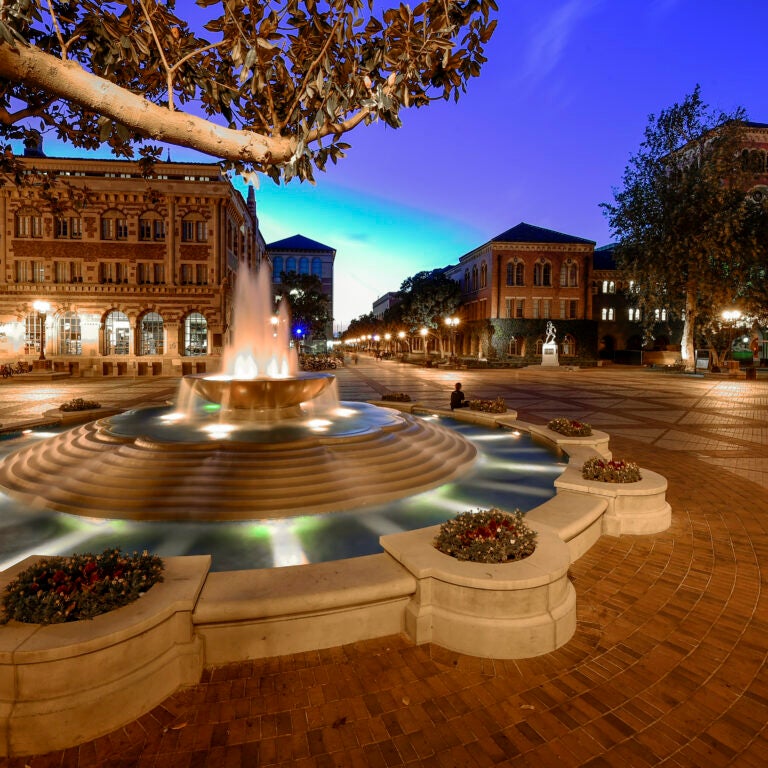

Summer research offers Trojan undergraduates numerous opportunities to transition from learning about discovery in the classroom to actively participating in it. (USC Photo)
Summertime for these Trojan undergrads means diving into research
USC offers unique opportunities for students to do hands-on, lifesaving research alongside faculty mentors.
USC Viterbi School of Engineering student Alexander Nibauer never expected to be spending the summer after his first year of college helping advance research into traumatic brain injuries and neurological disorders.
Yet the enthusiastic 19-year-old has been doing just that.
Working in USC Viterbi Assistant Professor Yasser Khan’s lab, Nibauer is part of a team developing extremely small sensors capable of detecting the body’s chemical messengers beyond today’s technology. By measuring these tiny biological signals, the team hopes to identify neurodegenerative diseases long before symptoms appear — leading to earlier diagnosis and treatment.
“This is the most incredible experience I’ve had,” Nibauer says while sitting at the Khan Lab in Michelson Hall on the USC University Park Campus. “I learn so much about the iterative process of research. It’s really rewarding when things work after you’ve logically debugged each problem along the way. I love that process.”
Learning across disciplines
Summer research like Nibauer’s offers Trojan undergraduates numerous opportunities to transition from learning about discovery in the classroom to actively participating in it, according to Ishwar K. Puri, senior vice president of research and innovation at USC.
“With fewer competing curricular demands, students can immerse themselves in complex questions, cultivate resilience and creativity, and develop habits for purposeful work, career success and satisfaction,” Puri says.
Puri, a USC Viterbi professor of aerospace and mechanical engineering, points out that undergraduate researchers bring “curiosity, energy and fresh perspectives to USC’s labs, studios, archives and field sites, strengthening our research expertise and preparing the next generation of scholars, innovators and leaders.”
Making sacrifices and staying focused
USC Alfred E. Mann School of Pharmacy and Pharmaceutical Sciences senior Chichi Makasi has spent her summer working in a lab that is busy formulating a hepatoprotective compound — a substance that can protect the liver from damage — designed to lessen hangover effects after alcohol consumption.
The lab Makasi is working in, led by USC Mann Associate Dean for Undergraduate Education Daryl Davies, has her analyzing patient samples from a human clinical trial — an uncommon assignment for an undergraduate researcher.
Makasi explains that the hepatoprotective compound protects and supports liver and brain health independently of alcohol use. This may give the research broader medical applications for liver and brain health.
“You do get very much in the zone,” says Makasi, who is majoring in pharmacology and drug development. “Seeing everything we learn in class from a very hands-on perspective and performing that research has been eye-opening.”
From the classroom to the ‘warm room’
USC Dornsife College of Letters, Arts and Sciences junior Nico Matias is heavily involved this summer in microbiome research, focusing on E. coli and other bacteria under the supervision of USC Dornsife Professor Steven E. Finkel.
“I was a lab assistant cleaning test tubes and was going to do clinical research” at another lab, Matias says. “But then I fell in love with the research here — and the people.”
Part of Matias’ duties involve working in what is known as a “warm room,” which operates at around 100 degrees Fahrenheit with 80% humidity and requires that he wear protective gear. Matias prepares bacterial cultures in tubes — often threefold for accuracy — then transfers them to the warm room for growth. The room’s consistent temperature facilitates rapid bacterial replication and significantly accelerates experiment timelines.
Matias is collecting data on how ethanol, found in alcoholic beverages, and glycerol, a common preservative, may help bacteria survive longer, potentially disrupting the gut microbiome and contributing to disease.
“We are making new discoveries each day,” Matias says. “There is still a lot of dormant bacteria in our body that is playing a role in our well-being.
“It’s like you’re building a jigsaw puzzle without any of the pieces,” he adds. “You have to make the pieces yourself. I think that’s what makes this work feel really meaningful.”
A hands-on experience

Juliette Deiss, a USC Dornsife sophomore studying quantitative biology and business finance, is spending her summer doing computational research.
Deiss spends an average of seven hours a day working at USC Dornsife’s Convergent Science Institute in Cancer focused on the analysis of patient blood samples for cancer cell detection.
She works under the supervision of USC Dornsife Professor Peter Kuhn, director of the institute, which works on solving problems in cancer by combining patient data, lab models and detailed cell data with smart computer programs.
Deiss investigates how imaging conditions affect the detection of circulating tumor cells, extremely rare cancer cells that can appear as infrequently as 1 in 1 million blood cells. This work could enhance the clarity and speed of the lab’s imaging pipeline and enable it to handle a larger scale of liquid biopsy technologies for cancer detection and monitoring.
“I could do this work on my laptop from home,” Deiss says. “But I choose to come in every day and ask questions. It’s made me want to explore sciences much deeper — I’ve already learned so much from the professors and the students.”
USC Leonard Davis School of Gerontology junior Anna Entin is spending her summer months at The Sanabria Lab working under Assistant Professor of Gerontology Ryo Sanabria. Entin is researching how the aging process can be slowed by commandeering cellular stress responses, which involves triggering the body’s survival mode with a non-danger event.
The research involves trying to better understand how the proteins of the tardigrade — an extremely resilient micro-animal — can affect aging and lifespan in worms.
“We’re an aging and stress lab, so we’re really looking at how the stress response can promote healthy aging and extend the lifespan,” Entin says.
She started the project in her sophomore year and is currently compiling data to submit a paper — a rarity for an undergraduate student — by the end of the summer.
“During the summer you get to set up more experiments because you just have the time,” Entin says. “When we’re doing an experiment, we have absolutely no idea what’s going to happen. You’re figuring it out as you go, and I think it’s exciting to be so involved in the process of discovering new things.”
Enthusiasm leads to a coveted invitation
Alexander Nibauer’s interest in research was evident from the start. Even before spring semester started, he had already approached Khan about joining his lab. By the time classes ended in May, Nibauer had earned the opportunity to conduct in full-time research at the Khan Lab — eight hours a day, five days a week.
From Khan’s perspective, Nibauer embodies the curiosity and persistence needed to thrive in his lab, which develops sensor systems for precision health and psychiatry.
“If we see that spark, we engage them in research right away,” says Khan, who has noticed that if a student can dedicate one summer to research, they’re likely to stay in research. “The students at USC are getting very early the same experience other institutions provide later in their training.”


