
USC President Beong-Soo Kim speaks at the Holocaust Remembrance Day event. (USC Photo/Brian van der Brug)
USC Shoah Foundation marks Holocaust Remembrance Day by honoring survivors and their stories
The event commemorating Yom HaShoah explored the power of storytelling to educate, connect and inspire social change.
Holocaust survivor Yetta Kane was just 8 years old in 1941 when she and her family of five fled to the forest to escape mass shootings of Jews by the Nazis. They left their rural village in Poland with only the clothes on their backs and limited supplies, surviving pursuit by German and Polish soldiers with dogs, near starvation and in freezing conditions. After making their way to Russia, they were sent to a work camp in frigid Siberia for the duration of World War II. While conditions were severe, avoiding death camps where Jews and others were systematically murdered allowed her family to survive.
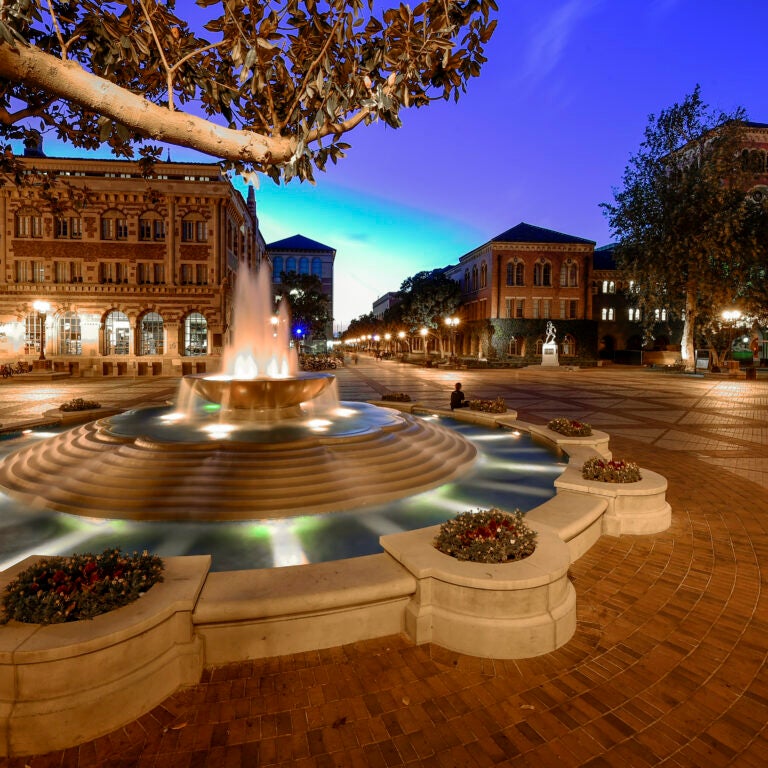
In 1995, Kane shared her incredible story of survival in a filmed interview with the USC Shoah Foundation — The Institute for Visual History and Education, which was established by filmmaker Steven Spielberg in 1994. On Monday, during a commemoration of Yom HaShoah (Holocaust Remembrance Day) at the USC Shoah Foundation headquarters on the USC University Park Campus, Kane, who is 93 and now lives in Long Beach, reflected on the legacy of her video testimony.
“I hope [viewers] will learn from experiences of people like me,” Kane said through tears while holding the hand of her granddaughter Emily Kane Miller. Her main motivation in sharing her story with the organization and with audiences at schools and museums has been to inspire others “to be inclusive, to be loving, to be kind, to shine a light when there is darkness, in any way we can,” she said.

(USC Photo/Brian van der Brug)
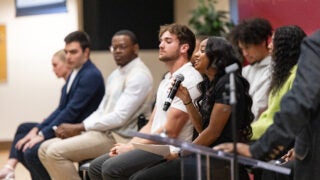
Supporters of the USC Shoah Foundation and USC leaders gathered to honor Holocaust survivors and mourn the more than 6 million Jews who perished in the Holocaust. Kane and her granddaughter spoke as part of a panel discussion with two current USC students exploring how survivor testimonies reverberate across generations and the responsibilities that emerge as stories of the Holocaust are carried forward.
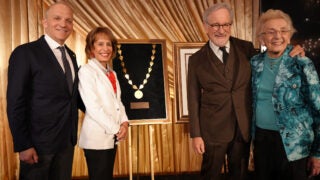
The panel’s theme, “Dialogue Among the Generations,” reflected the USC Shoah Foundation’s mission: to record, preserve and share survivor and witness testimonies from the Holocaust and other mass atrocities and genocidal crimes of the 20th and 21st centuries. Spielberg entrusted USC with the stewardship of the organization and its audiovisual archive in 2006. The archive, which now contains about 63,000 survivor testimonies, is the largest such collection in the world.
“Bringing these voices from the past into our present moment allows us to shape policy, research and education, and it instills in us, as well, a moral obligation,” USC President Beong-Soo Kim said at the event. “We are all witnesses, and we are called, each one of us, to renounce indifference and embrace knowledge and mutual respect. I want to say to Yetta and to the tens of thousands of survivors who have shared their testimonies with us: Thank you for entrusting us with your stories. We count the responsibility here at USC to preserve these stories in perpetuity as a sacred duty and obligation.”
USC Shoah Foundation: Engaging with survivor stories across generations
Yom HaShoah is celebrated internationally by Jewish communities and others through ceremonies and educational programs. This year, it was observed from sundown Monday to nightfall Tuesday. The date — the 27th day of Nisan on the Hebrew calendar, which usually falls in April or May on the Gregorian calendar — was chosen in 1951 by Holocaust survivors in Israel. It coincides with the anniversary of the 1943 Warsaw Ghetto Uprising, when Jews in German-occupied Poland fought against SS and other German troops to try to prevent the deportation of tens of thousands of Jews to death camps.
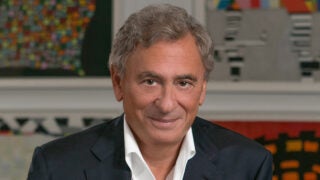
“We must never forget that the victims and the survivors of the Holocaust were not passive witnesses to their fate,” said Robert Williams, chief executive officer and Finci-Viterbi Chair of the USC Shoah Foundation. “Many Jews fought back. Many resisted in other ways, and all had agency and innate humanity.”
Survivor testimonies in the audiovisual archive speak to that profound human spirit. In her opening remarks, Catherine Clark, senior director of programs at the USC Shoah Foundation, emphasized “the importance not just of preserving survivor voices, but of activating them, ensuring that they are brought to life and inherited by successive generations,” she said. The organization’s many research and educational programs foster engagement by students, scholars and community members.
Jaxson Blum, a first-year international relations major at the USC Dornsife College of Letters, Arts and Sciences who was a panelist at the event, was introduced to Holocaust history as a high school junior through the USC Shoah Foundation’s William P. Lauder Junior Internship Program for middle school and high school students. Though he does not come from a Jewish background, Blum was so compelled by the organization’s work that he joined the team as a USC student intern.
Rather than a dry experience of studying history, “you’re more being brought into these memories from the past,” Blum said of engaging with testimonies in the archive. “I think that’s incredibly powerful, that someone across time can share their story with you without even knowing it. I think with that comes a responsibility … to carry these stories into areas where people don’t understand what this testimony really means.”
Panelist Alyssa Hope, a junior political science major at USC Dornsife who is on the women’s track and field team, deepened her understanding of the Holocaust through participating in the USC Shoah Foundation’s Student Leadership Summit, which sends groups of USC student-athletes to Europe to tour the Auschwitz-Birkenau concentration camp.
“It was just such an emotional experience to not even have Jewish blood or background, but just to feel the energy and the loss that was in that place,” Hope said. “It moved me to become an intern here and to also go back on the second trip to Germany to learn more about the life of Jewish people outside of the Holocaust, because I think that’s also important to see them as people, not just survivors.”
Panel moderator Jenna Leventhal, the organization’s senior director of administration, said that the students’ reflections “remind us that you don’t have to have a personal family connection to the Holocaust to care about this work, to feel moved by the testimonies in the archive and to carry survivor stories with you.”
Strengthening family ties and guarding against hatred
After several years in a displaced persons camp following the end of World War II, Kane’s family immigrated to Los Angeles in 1949. She met and married her late husband, David Kane, also a Holocaust survivor from Poland, in L.A. and started a family that now includes three children, six grandchildren and nine great-grandchildren. But the couple didn’t talk about their survival experiences with their children when they were young.
“We did not want to burden them with our pain, with our agony,” Kane said in a clip from her 1995 video testimony with David Kane that was shown before the panel discussion. That testimony proved to be a turning point.
“One of the things that I think really shifted in the 1990s because of the Shoah Foundation was that my grandparents realized that strangers knew our family story better than we did,” Kane Miller said. “They began to tell us, the grandkids, and their children their story.”
Learning that she had “survivors’ DNA” became a motivating force in her life. “God forbid something like [the Holocaust] ever happened or should ever happen, but I think there’s so many of us that use [survivorship] in a way to platform positivity and joy and hope,” said Kane Miller, who has spent her career working for social change and is pregnant with her fourth child.
Kane Miller also views survivor testimonies like her grandparents’ as a kind of inoculation against bigotry. “In the same way that vaccines can protect us from diseases, sharing stories like these stories and giving people just a little bit of the essence of that pain is like a vaccine for future hatred,” she said.
Creating community through storytelling
After the panel discussion, attendees were invited to tour the USC Shoah Foundation headquarters and to experience Kane’s “interactive biography.” Part of the organization’s Dimensions in Testimony project, interactive biographies allow people to have virtual conversations with Holocaust survivors. As viewers ask questions, AI technology prompts real-time responses from a pre-recorded 3D video interview. Kane recorded hers in 2024.
The organization’s interactive biographies have been shared at museums across the United States and the world, allowing survivor stories to travel far and wide. As the last living Holocaust survivors enter old age, the technology is also a way to preserve interactivity with them for future generations.
While these virtual experiences serve a unique purpose, Monday’s event underscored the power of sharing stories in the flesh — and in community.
Olivia Ucuzoglu of Rancho Palos Verdes, who attended the event with her husband, Isadore, a 1975 graduate of the USC School of Business Administration (now the USC Marshall School of Business), appreciated the immediacy of hearing Kane and Kane Miller share their experiences. “I’ve read many books on the Holocaust, but there’s something very different about sitting almost face to face with a Holocaust survivor and hearing firsthand their story and how it shaped their lives and the lives of their families,” Olivia Ucuzoglu said.
Listening to Kane’s story had personal resonance for Suzi Weiss-Fischmann, who attended the event with her husband, George Fischmann, and whose mother, an Auschwitz survivor, shared her testimony with the organization. “It’s very emotional,” said Weiss-Fischmann of L.A., a supporter of the USC Shoah Foundation’s International Teacher Training program. “It brings back those memories of how much I miss my mom and what she went through.”
The USC Shoah Foundation board of councilors member and L.A. resident Janine Lowy — whose father, a Holocaust survivor, shared his testimony in the archive — appreciated the camaraderie of gathering with other descendants of survivors on a day as important as Yom HaShoah.
“It’s a sense of comfort that you’re with other people that have experienced a life that was similar to yours,” Lowy said.