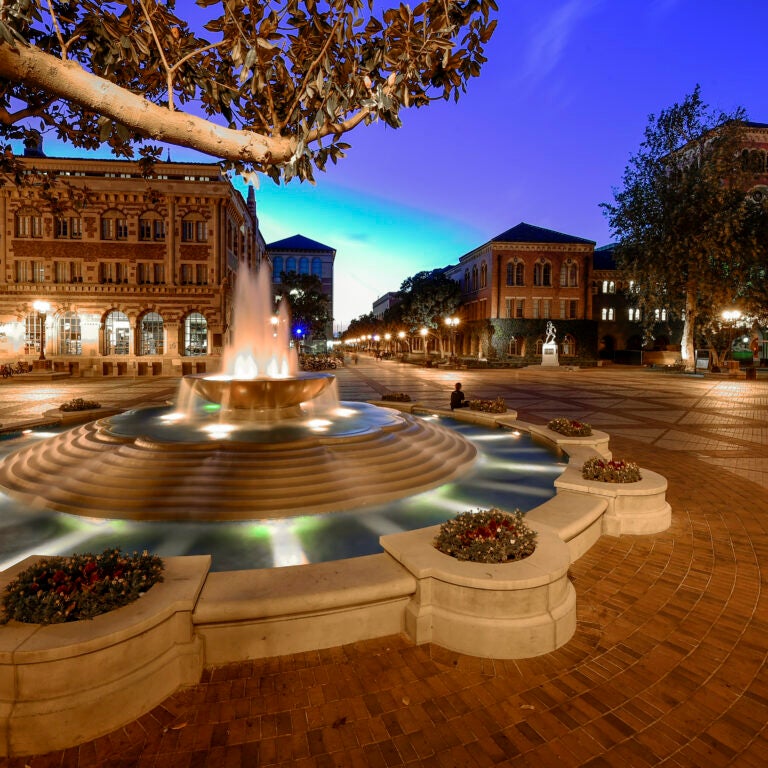

The Demo Day event exposed the USC-connected founders to potential investors, mentors and other members of the Trojan community. (USC Photo/Sean Dube)
USC startups pitch big ideas at Techstars ‘Demo Day’
Eight Trojan startups — tackling topics as varied as women’s health and robotics — pitched their cases during Demo Day for USC and Techstars.
One startup is building the talent pipeline for the AI era. Another is giving patients access to respiratory care from their own living rooms. A third is returning millions in unclaimed property to people who don’t know they’re owed it.
What they have in common: a USC connection, a big idea and three months to prove it.
These were among the eight founders who took the stage June 9 at the second annual Demo Day for the USC and Techstars Program, pitching to a room of potential investors, mentors and members of the Trojan community.
“We’ve built an innovation ecosystem that runs deep across this university,” said Ishwar K. Puri, USC’s senior vice president of research and innovation. “Every one of these founders carries the potential to shape our nation’s future.”
From weekend brainstorm to investor pitch
Getting to Demo Day takes about a year. The program begins with Startup Weekend, where entrepreneurs come together to brainstorm and shape ideas for products or services. From there, the most promising move into University Catalyst, a 10-week online program focused on early commercialization, and then into the Accelerator: a full-time, three-month program that culminates in the Demo Day pitch. Techstars, a global venture capital firm and startup accelerator, provides up to $220,000 in funding in exchange for a small ownership stake.

The program is open to anyone in the Trojan orbit: students, alumni, faculty and staff — and this year, the parent of a student. Eleven of USC’s schools were represented in the cohort.
“It really taps into the incredible richness and diversity of thought and creativity that is USC,” said Gabriel Schlumberger, managing director of USC and Techstars. “So, this really is a reflection of all the amazing things that USC does.”
The pitches — and the people behind them
• Charlyn Bender spent 30 years as a deputy district attorney before turning to a problem she’d lived with her entire adult life. The USC Marshall School of Business alum’s company, Avarie Femcare, makes an ultra-absorbent menstrual pad tested against real blood viscosity — not the saline solution major manufacturers use — and absorbs 87% more than leading brands.

• Claimio, formerly Blue Navy Recovery, is going after money most people don’t know they’re missing: 1 in 7 Americans may have unclaimed property sitting in a state government account — forgotten bank accounts, uncashed checks, lapsed insurance policies. Nationwide, those assets total more than $72 billion. The company helps people find and reclaim what’s theirs, with no upfront fees, and has recovered more than $7.5 million for more than 1,000 clients.
• Drafted is building the talent pipeline for the AI era. The company partners with universities to integrate real-world artificial intelligence projects into coursework, allowing students to contribute directly to the development of frontier AI systems. In the process, AI companies gain access to trained, institutionally vetted contributors, while students get hands-on experience working on some of the field’s most advanced technologies.
• Most patients with chronic lung disease never complete pulmonary rehabilitation, because clinics are too far away and waitlists too long. While patients often wait for care, FlexTogether can connect them with physical, occupational and respiratory therapists in as little as a week, entirely via video. The company grew out of a family story: USC Marshall alums Emily Mischel and Benji Rostoker built the program, then enrolled Mischel’s grandmother as she recovered from a respiratory condition with one goal in mind: dancing at Mischel’s wedding. (She did.)

• Sisters Amanda Roessler and Jessica Koosed Etting grew up watching their mom run the household from a bulletin board and a six-inch day planner. As adults with kids of their own, they went looking for a modern equivalent and couldn’t find one. So, they built it. Jam is an AI-powered family calendar designed to reduce the mental load that falls on parents, combining schedules, to-dos and reminders in one place.
• An AI-powered influencer marketing platform, nowfluence, is aimed at brands that run creator/influencer campaigns. Instead of managing influencers through spreadsheets, DMs, emails and manual tracking, it provides software to automate much of the process.
• Nick Wettels has spent 20 years on one problem: giving robots a sense of touch. The USC Viterbi alum and retired Navy commander co-founded two companies in the space and won a top Institute of Electrical and Electronics Engineers innovation award before launching Sensate Robotics, which develops tactile sensors and gripping systems for industries, like agriculture, where automation has yet to reach the most demanding work. The pitch included video of its first real-world test: sorting avocados.
• VascAI is an AI-powered platform that helps community health workers and care teams manage patient outreach, follow-ups, care coordination, documentation and chronic disease management. By automating administrative tasks and patient engagement workflows, VascAI enables community health workers to spend more time supporting patients and addressing social and health needs in their communities.


