
Members of the oldest improv group at USC, Comedus Interruptus, perform outside Bovard.(USC Photo/Caleb Griffin)
The serious power of comedy
At USC, comedy is more than a path to stardom; it’s a practical skill across disciplines.
Taylor Renneker needed a break from her science-heavy course load.
As a biological sciences major and presidential scholar at the USC Dornsife College of Letters, Arts and Sciences, Renneker knew she needed one class that would engage a different part of her brain. So, she consulted the go-to course finder for many students her age: TikTok.
“That might seem super Gen Z of me,” Renneker says with a laugh. “Most of my classes are biology labs and science courses, so I was looking for something more fun.”
The video promoted a medical clowning course at the USC School of Dramatic Arts. The course and professor got rave reviews.
Renneker was sold, and she convinced several friends to take it with her. “I was somebody who would never put myself out there,” Renneker says. “But there’s so much you can learn from comedy; I learned a lot from it.”
Renneker’s story of discovering a love for comedy at USC isn’t unusual. The university boasts numerous student comedy groups on campus with famous alumni such as Will Ferrell and Judd Apatow, as well as a renowned comedy minor at the USC School of Cinematic Arts, and both a major and minor program at the School of Dramatic Arts.
Beginning with the School of Cinematic Arts’ comedy minor in 2010, the university has since built one of the most robust comedy ecosystems in higher education. At USC Comedy, students learn how to write, direct, edit and produce comedy while also learning the history and theory of the art form.
There are all these different ways to access the comedy culture at USC.
Zach Steel, director of comedy at School of Dramatic Arts
USC’s comedy offerings have made the university a destination for aspiring comedians and comedy writers, but some students, like Renneker, have no intention of being a comedian or writing for comedy. They are engineering, business and humanities majors. Some are on the pre-med track or aspire to attend law school. Regardless of their area of study, these students have discovered how comedy can be applied to their chosen career path.
“There are all these different ways to access the comedy culture at USC,” says Zach Steel, director of comedy at School of Dramatic Arts and Renneker’s medical clowning professor. “USC has a very diverse student body, and often the students at USC — and I have witnessed this firsthand — are funny in ways that they don’t see reflected on TV or in the theater or in the movies.”
A comedy pipeline
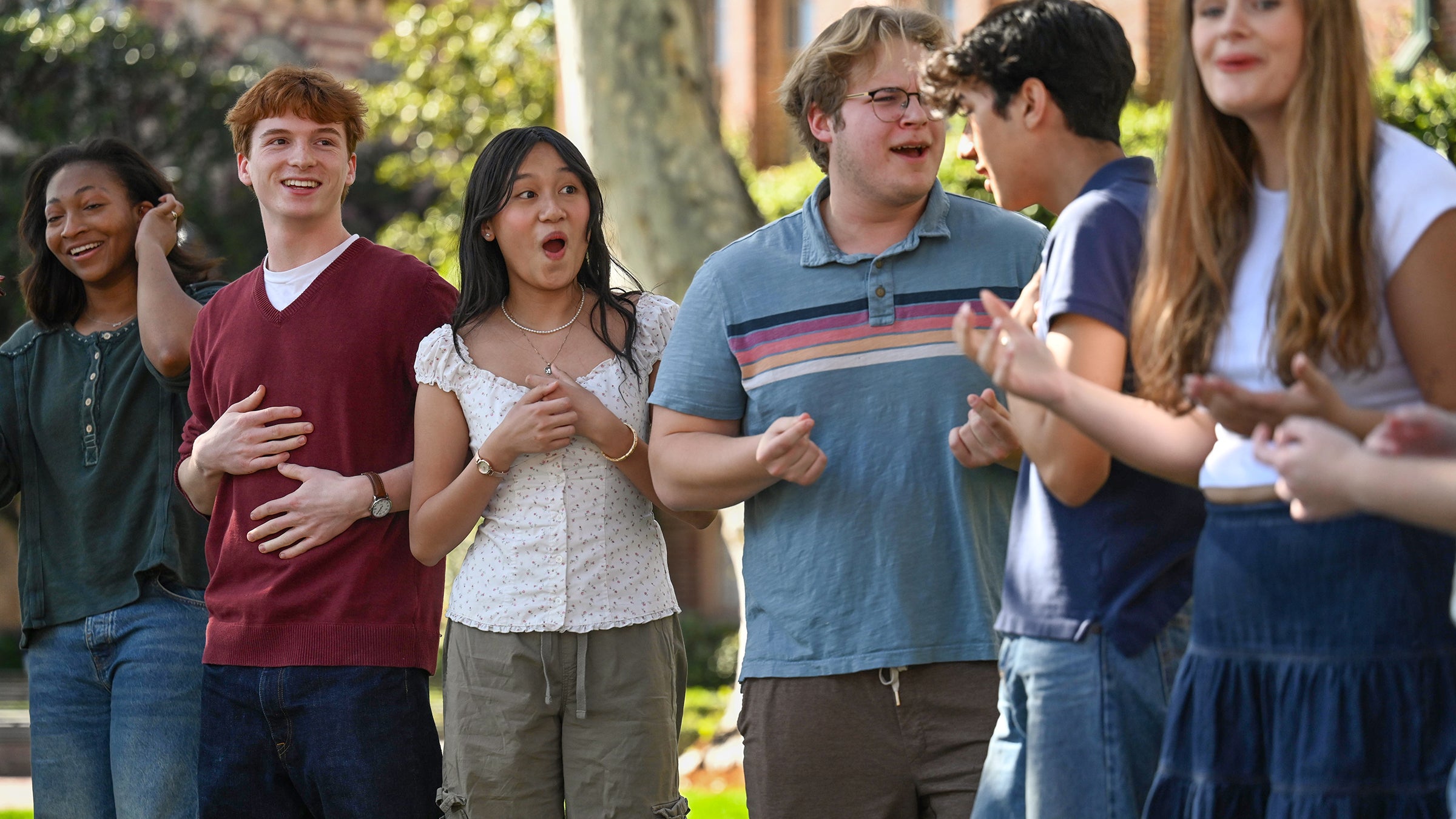
Dani Brown came to USC to be a comedian — no backup plan required.
A junior theater and comedy student at School of Dramatic Arts, Brown auditioned for Second Nature Improv — one of the oldest improv troupes on campus — knowing she was exactly where she needed to be.
“There was never an alternative in my mind,” Brown says. “If I were going to pursue comedy, then I would have to commit 100% of myself to it.”
She’s far from alone. Eli Buettner, a sophomore at School of Dramatic Arts and Brown’s Second Nature castmate, came to USC to do just that as well. After attending a USC summer program in high school, he realized comedy could be more than a hobby.
“It was only when I came here that I realized that comedy is so much bigger than performing a silly character in a play — it is an entire career,” Buettner says.
They’re at the right place. USC has earned a reputation as a comedy pipeline. Former Saturday Night Live cast members Ego Nwodim (USC Dornsife), Kyle Mooney (School of Cinematic Arts) and Beck Bennett (School of Dramatic Arts) all honed their skills on campus, with Mooney and Bennett as members of Commedus Interruptus, the university’s oldest improv group.
“They put Kyle Mooney and Beck Bennett’s face on the poster at the involvement fair,” says Hannah Moore, a senior member of Commedus Interruptus. “It worked because Commedus was the only group I auditioned for.”
For those who gravitate toward writing as opposed to pure improv, there is The Suspenders, USC’s oldest sketch comedy group. Frankie Alvarez Lora joined The Suspenders with no previous sketch-writing experience — just a big love for Saturday Night Live.
“It unlocked a whole new field of possibilities,” says Alvarez Lora, a senior theater major at School of Dramatic Arts. “From there, I took classes on improv and stand-up, which have been the most important aspects of my time at USC.”
Learning from the best
That culture is shaped in part by faculty who helped define modern television comedy.
David Isaacs, professor of screen and television writing at School of Cinematic Arts, has worked on shows such as M*A*S*H, The Simpsons, Frasier, Becker, Mad Men and Cheers — the last of which won him an Emmy.
“I started in the golden age of TV comedy — shows like All in the Family, M*A*S*H, The Mary Tyler Moore Show, The Bob Newhart Show, The Odd Couple, Happy Days,” Isaacs says. “I wanted to write for any of those shows, and I watched them religiously as well, so I saw where I wanted to go.”
Isaacs helped design the comedy program with School of Cinematic Arts Professors Barnet Kellman and Jack Epps to expand on existing comedy writing classes. “We tried to put everything under a big umbrella,” Isaacs says.
What started as a course on writing a half-hour comedy pilot became a full 18-unit minor. “If you want to study comedy or to develop your comedy voice, there’s probably no other university in America that has the access and the courses that we do,” Isaacs adds.
If you want to study comedy or to develop your comedy voice, there’s probably no other university in America that has the access and the courses that we do.
David Isaacs, professor of screen and television writing at School of Cinematic Arts
Alumni of School of Cinematic Arts have contributed to late-night programs, animated series and sitcoms, bringing with them the school’s strong foundation in structure and genre. Isaacs himself teaches a course on writing the 30-minute sitcom, where he has helped reinforce USC’s reputation as a pipeline into mainstream television comedy.
“I’m 76 years old, and I’ve told my wife that I’ll do this until I feel like I’m not as sharp as I once was,” Isaacs says. “But my love for comedy has never stopped and never will until my dying day.”
While Isaacs focuses on the writing side of USC’s comedy education, Steel teaches everything from improv to stand-up and, of course, medical clowning.
“Our foundational comedy classes are improv and stand-up in terms of performance, and either one is kind of a really sweet inroad into this world,” says Steel, associate professor of theatre practice. “They both kind of philosophically come from that same place of courage.”
Steel has been featured in shows such as Key & Peele, Parenthood and Shameless, and has lent his voice to shows including Steven Universe and Craig of the Creek. He arrived at the university in 2014 and has seen comedy at USC grow from a few classes into a full-fledged, nationally recognized program that includes non-performing arts students.
“This isn’t a ‘you either have it or you don’t’ type of experience,” Steel says. “We can all learn what our role is in comedy, and that’s kind of our superpower as comedy faculty — to provide a space for them to discover what makes them funny.”
Skills learned and prospects
Comedy’s interdisciplinary approach at USC leads to results that extend beyond Hollywood. Students can try their hands at comedy in almost every way imaginable, learning how skills in one field lend themselves to another.
Pablo Rodriguez, a Second Nature cast member, had never given comedy a thought prior to USC. An international relations major at USC Dornsife, Rodriguez found out that comedy applies to more than just the stage and screen, and there is no better place to explore that than USC.
“We have this saying in improv: ‘Follow your foot,’” he says. “It means go on stage and whatever idea you have, just do it and get it out there. That philosophy has really helped me participate more in class discussions, debates, public speaking and engaging with diverse perspectives. It’s all about being able to step in and be confident in your ideas.”
That interdisciplinary impact is increasingly central to USC’s approach. Students across majors — from theater to international relations — use comedy to sharpen storytelling, communication and creative risk-taking.
For Alvarez Lora, the motivation remains simple.
“My ultimate goal is to keep making people laugh for as long as I can,” he says. “That gives me more joy than anything.”
As Moore explains, USC’s comedy legacy is defined by its sustained influence on students, whether or not they want to become professional comedians and writers. “It’s so cool to see a thriving comedy scene where people with different career aspirations get to have fun and try something out,” Moore says. “USC is the best place for it — and I’m so lucky to be a part of it.”


